
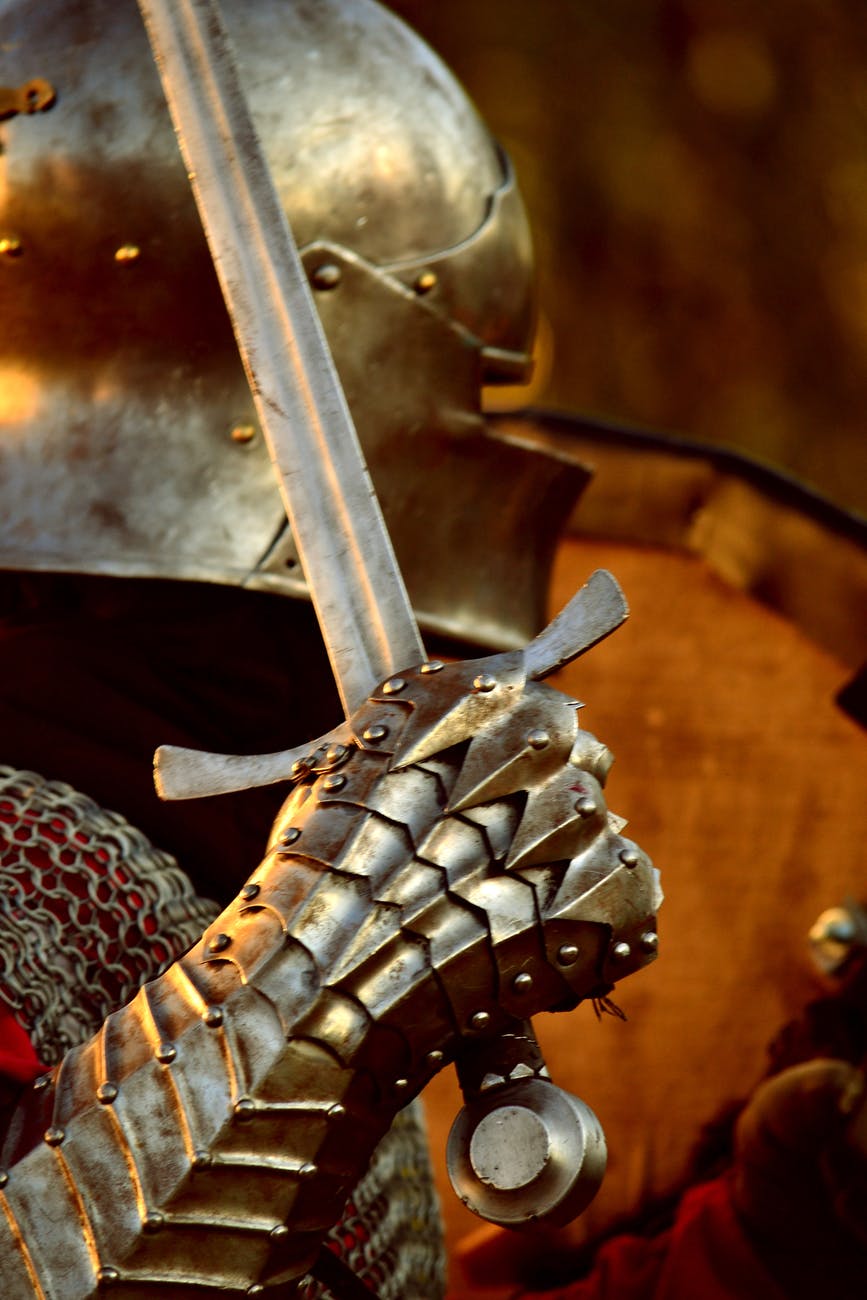
Dragon-Slayer

When I was in college, I had the privilege of babysitting my pastor’s kids. One of my favorite parts was putting them to bed. No, not the fact that they were going to sleep so I could dig into the peanut butter chocolate swirl ice cream in the freezer, but because I told bedtime stories. 

I told the younger girls stories of princesses who had adventures with mermaids and fairies. After goodnight kisses and making sure all the essential blankies were in bed, I went downstairs to the boys’s room to tell their stories. 

Sir Jake and Sir Jimmy were two brave knights who defended their father’s kingdom, learned about teamwork, and fought dragons, trolls, and ogres. I wove in elements of sacrifice, glory, and duty. The knights failed at times, but learned they could always count on their father, the king, because he was the ultimate dragon-slayer. 

In retrospect, I gave much more attention to the boys’ stories, mostly because the girls were younger and didn’t need sweeping plot lines to entertain them. However if I could go back, I would tell similar stories to the girls. Trust in and fight for the Dragon-Slayer. 

Big Picture

The box office successes of The Lord of the Rings, The Hobbit, Stars Wars, and Game of Thrones shows our culture’s thirst for epic, sweeping adventures that weave together individual characters and events into a grand story. We long to be part of something bigger than ourselves.

In The Lord of the Rings, Frodo and Sam seem small and alone on the journey to destroy the ring in Mount Doom, yet the reader knows that everyone else is working hard for the same end. Frodo and Sam reach Mount Doom because Gandalf and Aragorn draw out the enemy and clear their path. The Ring is finally destroyed, despite Frodo’s succumbing to its power, by Gollum, who wants the ring for himself, but is destroyed along with it. Frodo and Sam were only a piece of the story. A pivotal piece, but a piece nonetheless. 

This resonates with us because we too want to be a part of something bigger than ourselves. Culture tells us that we are enough, that if we look deep down, we’ll find the strength and power we need to be the main character of our own stories. 

However our culture is full of symptoms that this mindset is toxic. Drug use and opioid crises wreak havoc with addiction, abuse, and overdose. According to the American Foundation for Suicide Prevention, there are 129 suicides a day. Anxiety and depression are common-place. Sex is cheap and meaningless. When we look to ourselves for meaning and purpose, we only go deeper in our depravity and darkness. 

Our Dragon-Slayer

The good news is that we are part of a bigger story. God created this world out of nothing for his glory. When the first people on the earth, Adam and Eve, chose to disobey God, sin entered the world, and it broke everything. It wrecked our relationship with God, each other, and the world. We were enslaved to our sin and to Satan, the dragon (Rev. 12, 20). 

However God, in his mercy, sent his son Jesus Christ to live the perfect life we could not. He died on the cross in the horrible death that we deserve as just punishment for our sins. Jesus rose again on the third day, conquering death, sin, and the dragon. 

Jesus is our Hero. He offers forgiveness to all who call on the name of the Lord, and eternal life in resurrected bodies after he returns at his appointed hour. 

This is God’s story. A story of hope. A story of love. A story that you could have a part in if you are a follower of Jesus Christ. 

If you are a follower of Jesus, take heart! This darkness will not last, indeed Jesus has already landed the death stroke of the dark dragon (Satan) who rules these lands.

If you don’t know Jesus, I plead with you to come and meet the good God who created you, loves you, and offers you eternal hope and life in Christ Jesus. 

You have a part to play in God’s story. Come and adore the great Dragon-Slayer!

Did Jesus Really Need to Die?

The smoky bustle of a cafe swirled around my friend and I as we talked. I sipped mint tea from a small glass as she stirred several packets of sugar into tiny coffee cup, a direct, the equivalent of a latte. We were talking about religion, a normal conversation in this Muslim country. Today we were discussing Jesus. When I mentioned his death, she stopped me. “No, Jesus is alive.” She beamed, reassuring me. I blinked in surprise as she went on. “He never died. Someone who looked like him died and God took him to heaven.”

While living among Muslims, I heard two things consistently: the Bible is corrupt (read this to address this claim) and Jesus didn’t die. I was always willing to talk about this, because truly, on these two things hinges the Christian faith.

Jesus’ death is more than a small historical detail that might’ve been smudged by time. It is only because of Jesus’ death that we have forgiveness of sins and salvation. The mercy of God is displayed in Jesus Christ. Without his death, Christianity loses its very essence.

Blood and Forgiveness

From the very beginning we see the act of substitution in God’s plan. When Adam and Eve disobeyed God (Gen. 3), they immediately realized their nakedness and were ashamed. They sewed fig leaves together to hide their naked shame. God punished them for their actions, casting them outside of the garden of Eden. However before they left, he made them clothes from animal skins. With the shedding of blood, he covered their shame.

Abraham was instructed by God to sacrifice his only son (Gen. 22). In obedience Abraham took his son to a mountain, trusting God was even able to bring his son back from the dead (Heb. 11:19). As Abraham raised the knife to sacrifice, an angel from God stopped him. God provided a ram to die in this son’s place. Again, an animal’s blood was shed in the place of a man.

Moses came and was given the law by God (Ex. 34:27-28, Deut. 31:9). Detailed instructions were given about the sacrificial system. The only way people could attain forgiveness from God, atonement of sin was to shed the blood of an animal, a sacrifice (Lev. 17:11, Heb. 9:22). Only blood could wash away the ugliness and stain of sin.

Prophets came and went, and one, Isaiah, promised that God would send a final, perfect sacrifice (Is. 53). Then God fell silent. 400 years passed. Where was this perfect lamb?

The Final Sacrifice

Then came Jesus. When the prophet John saw him, he declared,

“Behold, the Lamb of God, who takes away the sin of the world!…And I have seen and have borne witness that this is the Son of God.” John 1:29, 34

Jesus. Oh perfect, spotless Lamb! He chose to lay his life down in obedience to the Father (John 10:14-15, Luke 22:42). He did no wrong, yet he died a criminal’s death. He was crucified on a cross, a painful, slow, humiliating end. He was spat on, mocked, and beaten, yet he never opened his mouth. He who was perfectly righteous took on all our sin and shame, bearing every ounce of wrath from a holy God, the righteous judge. He was the final and complete sacrifice.

Jesus breathed his last. He was taken down from the cross and buried in a tomb. His body lay dead, empty. The Son of God, slain by men for men and the glory of the Father.

On the third day the ground shook. The pangs of death were loosed! He rose from the grave, alive forever, amen!

“Death is swallowed up in victory. O death, where is your victory? O death, where is your sting?” 1 Cor. 15:55

Hallelujah!

Believe in the Lamb

But now the righteousness of God has been manifested apart from the law, although the Law and the Prophets bear witness to it— the righteousness of God through faith in Jesus Christ for all who believe. For there is no distinction: for all have sinned and fall short of the glory of God, and are justified by his grace as a gift, through the redemption that is in Christ Jesus, whom God put forward as a propitiation by his blood, to be received by faith. This was to show God’s righteousness, because in his divine forbearance he had passed over former sins. It was to show his righteousness at the present time, so that he might be just and the justifier of the one who has faith in Jesus. Romans 3:21-26

This! This is why Jesus needed to die! If Jesus was just a good man, or just a prophet, we would be lost. Every one of us fall short of God’s standard of holiness and righteousness. No amount of good works will outweigh the bad works. As we see with Adam and Eve, just one sin is enough to cast us out of the presence of God.

We need a sacrifice. We need a perfect, flawless lamb to die in our place to get forgiveness of sin. Jesus provided that. He says,

“I am the way, and the truth, and the life. No one comes to the Father except through me.” John 14:6

There is one way. Jesus. The Bible says that you need only believe in the life, death, and resurrection of Jesus Christ, and you will be forgiven (Rom. 10:9). The righteousness of Jesus will be transferred to you, not in the future, not in the last day, but now. Today.

If believe in Jesus, rejoice! Don’t lose the wonder of the cross. May familiarity never cloud our thankfulness and awe of what he did on our behalf!

If you are not a follower of Jesus, I invite you to him. Don’t linger at a distance. Salvation awaits. Don’t wait another moment, as we aren’t promised anything beyond the breath in your lungs at this very moment. Come. Marvel. Repent and believe!

*I took this photo on my trip to Israel a few years ago. It is the garden tomb where some believe Jesus was buried. Check out this leaflet to learn more!*

Tomb-deathwhereisyourvictory

SaveSave