
Deep Breath Before the Plunge

In one of my favorite books, The Return of the King, Gandalf, the venerable wizard, and Pippin, the playful but maturing Hobbit, arrive at a major city at the cusp of an enormous battle. Everyone is on edge, waiting for it to start. Gandalf calls it “the deep breath before the plunge”. I’ve been here several times in my life, on the edge of something completely life-changing.

Before I left for college, the first person in my close-knit family to leave home, move to another state, and complete a bachelor’s degree. 

Before I moved overseas, to another country to learn a new, difficult language and be immersed in a new culture. 

Before I moved back to America, not knowing in the least what was next. 

Before I got married, choosing to trade singleness for lifelong partnership. 

And now, I sit at the cusp of adopting four children, ages two to seven. I’ve taken lots of deep breaths before this plunge. These quiet moments of preparation before my “normal” is completely turned upside down are precious, and frightening at times.

In the weeks or months leading up to a big change, my heart has a tug of war with itself. I don’t like change, yet God’s given me an adventuring spirit that is willing to go into uncharted territory. All the what-ifs swirl around my head. I am a champion at worst-case-scenarios, which makes for great story-telling, but leads to anxiety in my personal life. It is all too easy to spiral down into fear and despair, long before any difficult thing actually happens. I’ve had moments of panic, wondering what in the world I was thinking when I made this decision. Surely you can’t handle this. It’s too hard. It’s too big. And too uncomfortable. 

And while those things are true of every adventure I’ve embarked on, there is another truth that rings even truer. If God asked me to do this, he will be by my side supplying grace, strength, perseverance, and wisdom to accomplish it every step of the way. This is his plan, not mine. I’m not writing this story, he is. And I must trust the Author. 

Even if nothing of the rest of my life is as I planned, expected or hoped, I will still cry out, “I have no good apart from [God]!” (Ps. 16:2). He is my never-changing Rock of Ages in the midst of the enormous, approaching change. Everything around me will look different in a few weeks, but he is and always will be the same. 

Savior.

Provider.

Faith-giver.

Way-maker.

My Rock and fortress.

My God in whom I trust. 

This leap of faith says nothing about me. I will never be able to look back and boast, “Look at all the amazing things I did.” No. I don’t have any faith in my own abilities. I am weak. I have and will fail. No, all the good in me is God’s work. He get’s all the credit and glory. I’m just a vessel, a clay jar in which he hid his surpassing treasure. He is worthy and he is with me. I’m ready for the plunge. 

“But we have this treasure in jars of clay, to show that the surpassing power belongs to God and not to us.”

1 Corinthians 4:7

Waiting for the King

If 2020 had a Christmas ornament that summed up the year, it would be of a child with their nose pressed up against a window, gazing out expectantly. That is how I’ve felt. First, it was waiting for fertility treatments, then waiting for the pandemic to pass, and finally starting our adoption and waiting on approvals and matching. Waiting is difficult, and patience seems on short supply some days when nothing seems to be happening.

Waiting is very much in line with the season of Christmas advent. Advent is a season of waiting and longing. The first advent was for the appearing of the Messiah. The Old Testament was given through the prophets, God’s Word and messages to his people. He made a covenant with them, first with Abraham, and down through the patriarchs, but again and again, his people strayed. The law given to Moses could only condemn, not save. The sacrificial system only temporarily absolved sins, and the bloody sacrifices were repeated year after year to cover the sins of God’s people. God promised a Messiah, a final sacrifice. But where was he? Prophets, kings, and the very nation failed over and over. Their kingdom split. They were taken into exile. They were brought back to their country, only to have it occupied by the world superpowers. Where was this Messiah? Where was God? He fell silent for four hundred years between the writings of the prophet Malachi and the birth of Christ. Had he forsaken them? Had he forgotten them? 

In a moment of splendor, a bright star shone and angels sang in the sky to signal the fulfillment of the prophesies. Love came down in Jesus Christ. The Son of God became son of Man, infinite divinity merged with finite flesh. He was born in humble Bethlehem, not in a palace, but a humble stable. His mother, a virgin, and his father, a carpenter, had both seen angels, but now they saw the face of God in their babe. Shepherds saw the angels and came to worship. They rejoiced and told everyone what they had seen and heard. Wisemen travelled from the East, bringing gifts far beyond what his poor parents had ever seen. The heavens declared the glory of God and led the wisemen straight to God himself. But the fanfare, a brilliant flash in the dark of night, didn’t last long before Jesus was just a Jewish child, fleeing death as a refugee to Egypt, then returning with his parents to Nazareth in Rome-occupied Palestine. Thirty years passed, as far as the Bible tells us, ordinary and quiet. More waiting.

Jesus’ stepped out of anonymity at the right time, and began his ministry. He turned water into wine, healed the sick, lame, and demon possessed. He taught about the Kingdom of God and called them to repentance. He was sinless, baptized, ridiculed, followed, and revered. He called twelve disciples to follow him and they called him Rabbi (teacher), then the Christ. Religious leaders plotted to kill him, but in the end Jesus laid his own life down as the sacrificial Lamb, the final and perfect sacrifice. This time there were no angels singing in the skies. There was no brilliant star. Darkness came, and the earth shook as its Creator, the Word of God, died, forsaken by the Father God to punish the sins of the world. For three days, creation held its breath. The disciples hid, grieved and confused. More waiting.

In another flash of splendor, Jesus walked out of the tomb three days later, alive! He was raised to life, having conquered death in the grave. After seeing his disciples and some five hundred others, he left instructions to go to every nation and tell the good news of his salvation. He ascended into heaven to sit the right hand of Father God.

He is waiting even now to come again to usher in the new heavens and earth. That’s why we are still waiting, even though two thousand years ago he came, lived, died, and rose again. He’s not finished. Not even close. We live in this tension of the here but not yet. His Kingdom is here on earth in his people, the Church, but we are still waiting for the King to return and fully bring in the new heavens and earth. There is still sin, brokenness, and darkness here. But it won’t be like this forever. 

This is our hope. We are sojourners, exiles, and strangers in this world. This is not our home. This is why the Gospel is good news to the waiting, poor, sick, barren, imperfect, addicted, estranged, heart-broken, and needy. What we see here in this broken, sin-riddled world is not the end. We wait with eagerness, not hoping in what we can get here, or how comfortable we can make ourselves on earth. We are not of this world. The King is coming.

God calls us to be active waiters. We don’t hunker down and wait to die or for Jesus’ return. He tells us to love the Lord our God with all our hearts, souls, and strength, and to love our neighbors as ourselves. We wait, but we fight our sin and for light in the world. We wait, but we hope. We wait, knowing that one day our faith will be made sight, and we will worship around his throne for eternity, all darkness, sin, and death banished forever under the King’s rule and reign. 

What are you waiting on? Are you weary, irritated, and frustrated? Do not lose heart. He hasn’t forgotten you. The King is coming. 

A Seat at the Table

Friends of ours recently adopted a child from foster care. What a joy it was to walk with them through the process, from the time of placement when the child was 5 weeks old, to legal adoption at 2 years old. 

Our church small group hosted a party at church to celebrate the adoption. We made a taco bar, decorated with green, blue, and dinosaurs, and had a huge cake. The guest of honor was oblivious through the festivities, adorably so. 

When everyone was served, we made our plates and sat down at the table. The little guy crawled up in my lap, picked up my fork, and dug into my plate. I smiled, not just because I was clearly spoiling him, but because his little life was a beautiful illustration of what God does for us. 

Adoption is one of the blessings of salvation through Jesus Christ. He not only forgives our sin through the cross, but transfers us into an adoptive, paternal relationship with him. 

For those who are led by the Spirit of God are the children of God. The Spirit you received does not make you slaves, so that you live in fear again; rather, the Spirit you received brought about your adoption to sonship. And by him we cry, “Abba, Father.” The Spirit himself testifies with our spirit that we are God’s children.

Romans 8:14-16

Because of the work of Jesus, we have a place at God’s table. He doesn’t leave us crumbs. We have a seat, and even have the freedom and relationship to crawl up in his lap. He doesn’t withhold any spiritual blessing from us because of the glorious blood of Jesus. 

It’s not just a metaphorical table either. When God’s Kingdom is fully ushered in, we’ll eat the marriage feast of the Lamb in the presence of God. 

“Hallelujah!
For the Lord our God
    the Almighty reigns.
Let us rejoice and exult
    and give him the glory,
for the marriage of the Lamb has come,
    and his Bride has made herself ready;
it was granted her to clothe herself
    with fine linen, bright and pure”— for the fine linen is the righteous deeds of the saints. And the angel said to me, “Write this: Blessed are those who are invited to the marriage supper of the Lamb.”

Rev. 19:6a-9

Jesus secured our adoption and seat at the table. Praise him for his kindness and mercy in making us his daughters! 

The Secret to Contentment

Are you content? Is your house big enough? Is your work meaningful enough? Are your children good enough? Does your spouse do enough? Do you have enough?

Contentment is an elusive term, and even more of a difficult attitude to cultivate. We can tell ourselves we are content all we want, but deep in our hearts dissatisfaction lurks. We want more.

Search for Satisfaction

To be content is to be satisfied with what one has and not want more or anything else (dictionary.com). Contentment is being thankful for what we have, not always on the lookout for what we don’t. The root of contentment is satisfaction, and when we seek it from the wrong place, we come up empty, dissatisfied, and wanting.

Dissatisfaction is universal, but we Americans are grossly guilty of it. As a culture, we are materialistic, spoiled, and demand the best in all things. “The American Dream” has long represented riches many only dream about. Yet we are still deeply discontent and always looking for the next thing, relationship, or experience to make us happy.

Christians aren’t immune to it either. Dissatisfaction leads us to move from church to church in search of the “perfect” experience. It leads us to gossip about our sisters and brothers to tear them down and build ourselves up. It leads us to jealousy and fake smiles when another receives something we long for. Dissatisfaction leads us to sin.

Paul’s Secret to Contentment

As in all things, Scripture provides us with the tools and knowledge to find and cultivate contentment. In Philippians, Paul thanks the church of Philippi for supporting him financially. However, amid his thanks, he gives us a beautiful nugget on contentment.

Not that I am speaking of being in need, for I have learned in whatever situation I am to be content. I know how to be brought low, and I know how to abound. In any and every circumstance, I have learned the secret of facing plenty and hunger, abundance and need. I can do all things through him who strengthens me.

Phil. 4:11-13

Paul didn’t have a cushy life. In fact, much of the American Church would shrink away from the suffering that came with Paul’s obedience to the Lord.

 Five times I received at the hands of the Jews the forty lashes less one. Three times I was beaten with rods. Once I was stoned. Three times I was shipwrecked; a night and a day I was adrift at sea; on frequent journeys, in danger from rivers, danger from robbers, danger from my own people, danger from Gentiles, danger in the city, danger in the wilderness, danger at sea, danger from false brothers;  in toil and hardship, through many a sleepless night, in hunger and thirst, often without food, in cold and exposure. And, apart from other things, there is the daily pressure on me of my anxiety for all the churches.

2 Cor. 11:24-28

How could Paul, after enduring all those things, say that he was content and satisfied? His secret to contentment is this:

“I can do all things through Christ who strengthens me”.

God isn’t asking us to pull ourselves up by our bootstraps and muster up satisfaction all on our own. Like willpower, whatever satisfaction we conjure up for ourselves is fleeting. Popular self-help books tell us to “believe in ourselves” and “you are enough”. Scripture tells us this isn’t true. Only dependence on God and his strength will lead us to contentment in plenty and in need.

Our Ultimate Satisfaction

God offers himself as the key to our ultimate satisfaction and joy. He knew our deepest need, the need for a right relationship with him, and sent his Son Jesus to die on a cross for our sins. He defeated our greatest enemies, sin and death, to give us abundant life in Christ Jesus.

When we follow Jesus, his righteousness is transferred to us. We stand before God pure and clean, and he brings us into a relationship with him as a beloved child. Our greatest need is met in Jesus, therefore no matter what we face in this life, we can be satisfied and content. Our darkest day on earth is the closest we’ll ever get to hell. And not only that, but Paul goes on to say,

And my God will supply every need of yours according to his riches in glory in Christ Jesus. To our God and Father be glory forever and ever. Amen.

Phil. 4:19-20

God is a good father who loves to give good gifts (Matt. 7:7-11). He will provide for your needs in his perfect time.

Fight for Contentment

The battle for contentment is difficult, but necessary for Christians. How do we fight? Consider these action steps if you’re struggling to capture elusive contentment:

  • Ask God to show you the root of your dissatisfaction.
  • Repent of any sin that is stemming from your dissatisfaction (control, unbelief, impatience, critical spirit, etc).
  • Remember the Gospel and rest in the knowledge that your deepest need has already been met in Jesus.
  • Pray and ask the Lord to give you his strength to find satisfaction and contentment in your current circumstances.
  • Memorize scripture to fight for contentment when your wandering heart tries to return to dissatisfaction.
  • Share with an accountability partner.

God loves you and wants to satisfy your heart-of-hearts in Jesus Christ. Don’t try to find contentment in your things, relationships, or experiences. He knows you. He loves you. He will satisfy you.

The Sneaky Sin of Annoyance

Are you often annoyed? Recently I found myself discontent with my job, and as I dug deeper, I realized that I was working from a place of annoyance. I started my day anticipating annoyance, I became annoyed, then brought my annoyance home with me. 

Annoyance is often swept under the rug as a “little sin”. It’s not in the sin lists in 1 Corinthians, Galatians, Ephesians, and Colossians, so it must not be a big deal, right? Everyone gets annoyed. We’re human. We live in a broken world. It’s part of the deal. 

Yet as followers of Jesus, we must submit every part of our hearts to Christ. 

To annoy is to disturb or bother a person in a way that displeases, troubles, or slightly irritates (dictionary.com). You know the feeling. We stiffen our shoulders, furrow our brows, and bend our mouths in a frown. Our hearts grumble and groan in irritation, even if we manage to govern our body language.

What do we do when that bubble of annoyance rises in response to the day-to-day issues? 

Sin has Roots 

With my job, I was annoyed by the disruption of my schedule and the unpredictability that arose out of it. My annoyance was rooted in pride. I want to be in control, I’m not, so I’m annoyed. 

With behaviors like annoyance, it’s helpful to examine what the reaction is rooted in and where that particular sin is leading. 

Where would my job annoyance lead? I would descend into anger, discontentedness, and harshness towards others as I try to control and order my world according to my desires. 

If you are habitually annoyed about something or someone, take a moment to contemplate not just the source, but what sin your annoyance is rooted in and where it’s leading you. Sin always drags you deeper into the darkness. When you allow “small” sins to flourish, your flesh will take it one, two, or three steps further than you ever intended. 

Kill your Sin 

We must never be content with our pet sins. Christ died for our sins, yet we sometimes we pick and choose which ones we want to crucify and submit to his lordship. 

God wants us to walk in righteousness in all things. We won’t be perfect this side of eternity, but this is a battle we must fight as believers. “Be killing sin or it will be killing you” (John Owen). 

Let’s be honest. “I’m annoyed” is a more acceptable way of saying “I’m mildly angry”. Anger can be righteous (Scripture tells us that both God and Jesus were angry at times), but our anger is rarely righteous. Our anger is most often rooted in pride and selfishness. 

Scripture has a lot to say about anger. Wisdom literature is rife with examples of anger leading to sin and strife (Prov. 14:29, 29:22, Ecc. 7:9). 

Paul instructs is in Ephesians: 

Be angry and do not sin; do not let the sun go down on your anger, and give no opportunity to the devil.

Eph. 4:26-27

Let all bitterness and wrath and anger and clamor and slander be put away from you, along with all malice.

Ephesians 4:31

James also speaks to us about anger: 

Know this, my beloved brothers: let every person be quick to hear, slow to speak, slow to anger; for the anger of man does not produce the righteousness of God.

James 1:19-20

Annoyance also leads us to grumbling and complaining. Paul says in Phil. 2:14-15: 

Do all things without grumbling or disputing, that you may be blameless and innocent, children of God without blemish in the midst of a crooked and twisted generation, among whom you shine as lights in the world. 

Recalibrate your Response

When annoyance comes (and it will), consider these practical steps:

  • Take deep breath to calm your body.
  • Think through the sin-root of your annoyance and where it will lead. 
  • Confess sin (unbelief, pride, selfishness, etc). 
  • If you follow Jesus, remember God’s promise that you are forgiven in Christ. If you don’t have a relationship with God through Jesus, check this out.
  • Choose a scripture to memorize and meditate on to set your mind on Christ instead of yourself. 
  • Share with accountability partner(s) for prayer and support. 

Don’t let sneaky sins trip you and tear you down from the joy-filled, righteous life Christ purchased for you on the cross. Walk in freedom. 

Return to Sender

Can I have a different trial, please? 

Have you ever prayed this way? I have. When I’m in the middle of a difficulty, it’s tempting to look at someone else’s situation. I know their life isn’t perfect, but their trials look more appealing than mine. I want to exchange my trial with the receipt the way I’d return an ill-fitting piece of clothing. 

By the grace of God, that’s not how it works. 

Count it all joy, my brothers, when you meet trials of various kinds, for you know that the testing of your faith produces steadfastness. And let steadfastness have its full effect, that you may be perfect and complete, lacking in nothing.

James 1:2-4 

This is an oft-quoted verse to those experiencing suffering and trials. I memorized it in high school, and sometimes the eyes of my heart would roll. Could I really tell someone with cancer, a woman who lost a child, or a girl who had been abused, to count it all joy? 

I’m thankful the Lord deepened my faith and understanding of these verses. I was a skeptic because I believed that joy is only attainable through good circumstances. This cannot be farther from the truth. 

Joy Amid Suffering

Finding joy in the midst of a trial isn’t our natural inclination. James 1:2-4 commands us to count it all joy when we suffer, but it also gives us the reason for why we can count it all joy. 

For you know that the testing of your faith produces steadfastness.

James 1:3

Steadfastness is a steadiness, grit, and faithfulness that comes from weathering trials and suffering in a sin-broken world. What does steadfastness lead us to? 

And let steadfastness have its full effect, that you may be perfect and complete, lacking in nothing.

James 1:4

The end result of steadfastness is being made perfect, set apart and holy. God promises that one day our sanctification will be complete, and we will no longer be riddled by sin and brokenness. We will be like Jesus, but not before we join him in eternity. This is a sweet promise. God will finish the work he began in us (Phil. 1:6). 

Genuine Faith 

“In this you rejoice, though now for a little while, if necessary, you have been grieved by various trials, so that the tested genuineness of your faith—more precious than gold that perishes though it is tested by fire—may be found to result in praise and glory and honor at the revelation of Jesus Christ.

1 Peter 1:6-7

Peter tells us that because we are born again to a living hope (1 Peter 1:3), we rejoice, despite the grievous trials we face. God tells us that the end result of trials, genuine faith, is more precious than gold.

Later in James, we read that a man or woman without faith is like a wave on the sea, driven by the wind (James 1:6). A wave is dependent on outside forces to shape and drive it. Through trials and suffering, God develops faith and strength that aren’t dependent on things going on around us but are fixed on the solid and unchanging promises of God. 

In the end, only God knows exactly how he is shaping us in our suffering and trials. Just because someone else’s trial ended when they reached a certain point or had a certain realization, doesn’t mean ours will. God loves us too much to leave us in sin and complacency. He works in every trial and triumph to fix our eyes on him, root out sin, and grow our faith. 

Press On

Sister, if you are suffering or find yourself in a dark trial, I urge you to fight for joy. Not because of your circumstances, but because this specific, light, momentary trial is preparing you for an eternal weight of glory beyond all comparison (2 Cor. 4:17). God is working even when you can’t see it. He is refining and sanctifying you for your good and his glory. Trust your Creator.

He sees you. He loves you. He is with you. 

*If someone is abusing or harming you, you don’t have to go on without help or a way out. Reach out to a godly friend or a pastor for support and counsel.

Walking with the Waiting

This is to those in the Church who are walking alongside women who are in seasons of waiting for marriage and/or children. I’ve had women honestly and humbly say, “I’ve never struggled with singleness/infertility. I don’t know how to encourage you”. 

The good news is that single and childless women need to hear the same gospel truth the married and mothers need. As believers, we are sisters bound by the Spirit and united in our desperate need for a Savior. However, there are specific ways to encourage these women. 

Below I want to share some well-meaning phrases to avoid, and practical encouragements to build up the Body to love single and childless women well. 

“God is in Control”

As I have walked through eight years of singleness and currently am struggling with infertility, I hear this phrase a lot. It’s true, but my belief in the sovereignty of God is/was never my struggle. My belief in his character is/was always the root issue.

Really listen to your sister’s heart before you speak. Don’t assume that her experience and struggles are the same as yours. Listen closely to her heart. 

Whatever the root of her struggle, pray for your sister’s faith to increase. Encourage her to pray like the man in Mark 9, “I believe! Help my unbelief!” 

“You’re trying too hard. Let go and let God”

This was a frustrating, resounding gong the first year we tried to conceive. It tempted me to put my hope in something I could do to control my circumstances. 

Your single friend may be thinking about lowering her standards or considering going to another church to find prospective suitors. Your friend struggling with infertility may talk about it a lot, or chart what she eats to her BBT. Encourage her to work in the waiting, but ultimately she must put her trust in the Lord’s ways and timing. Remind her that God values faithfulness and obedience, and that her marital status or if she has children doesn’t determine her value and identity as a daughter of God. 

“If you really trust God, this shouldn’t hurt.”

This one was like a gut punch. Please don’t say this to your struggling sister. While feelings cannot be our guides, they are still part of the whole person God created in his image. It is possible to trust in the Lord with all your heart, yet still be pierced by pain, ache, and longing.

In John 11, Jesus’s friend Lazarus died. At the funeral Jesus wept, though he knew he could and would raise the man from the dead. This man of sorrows took time to recognize and join in the appropriate grief of his friend’s death. 

One of the kindest, most encouraging thing you can do for your sister is to sit and grieve with them. This may look like crying together in community group, letting her rock your baby, or listening to her talk over coffee. Acknowledge her grief and remind her of 1 Cor. 4:16-17.

  “So we do not lose heart. Though our outer self is wasting away, our inner self is being renewed day by day. For this light momentary affliction is preparing for us an eternal weight of glory beyond all comparison.”

1 Corinthians 4:16-17

“Your Eggs are Dying”

Unless your friend failed Sex Ed, you don’t need to remind her that her fertility window is shortening. She knows. I promise, she knows.

If she’s struggling with this, remind her that the God who created her knows her body and is able to even give Sara a baby in her nineties. In this age, there are many children already born and waiting in orphanages and foster care for a forever family.

With God all things are possible! 

Walk with Them

A great way to serve and bless sisters in these seasons is to invite them into your lives. They may not have kids for a playdate, but they can come over for dinner or game night. 

Consider them on holidays dedicated to celebrating what they don’t have but deeply desire. Have a girls night around Valentines day. Give her an extra big hug on Mother’s Day. 

Share your families with them. While you might be desperate for five minutes of peace, she might love to rock your baby, or get peppered by a million questions while she colors with your kiddos. 

Pray for them and let them know you’re praying for them. This has been a great comfort to me in seasons of waiting.

Spur them On

Finally, encourage your sisters to not waste this season. You’ve probably heard “singleness is a gift”, and so can seasons of childlessness, as unwanted as they may be. 

Your single sister may need to be spurred on to not wait around for Prince Charming, but to get out there and make use of this special season (or life) for the glory of God. 

For sisters struggling with infertility, this time also holds special potential. They may be able to volunteer, serve their local church, and have flexibility and availability that moms don’t have. 

Encourage your friend to look at her time and see if there are ways she can be using it for God’s glory, walking in faithfulness, working in the waiting. 

What God hasn’t Promised

During seasons of disappointment and struggle, we can take great comfort in the promises of God. He promises salvation through the life, death, and resurrection of Jesus Christ. He promised to do and finish the work of sanctification. He promised to never leave us through the deposit of the Holy Spirit.

However there are some things that aren’t promised in the Bible, specifically marriage and children. If you’re struggling with one of these, or know someone who is, you know the ache and brokenness of these unfulfilled desires. 

In the Bible we are told that Jesus, Paul, and others were unmarried. Paul says in 1 Corinthians 7 that marriage divides your affections between your spouse and God, but a single man or woman is only concerned about pleasing God.

There are multiple references to barren women (Sarai, Rebekah, Hannah, Elizabeth), and Prov. 30:16 even describes Sheol (hell) as a barren womb. However every Christian can reproduce spiritual children in making disciples. Paul refers to Timothy as a true child in the faith (1 Tim. 1:2).

Good Desires

Both marriage and children are blessings and good desires. Having a good desire is not a sin, but trying to fulfill that desire outside of God’s good boundaries, we fall into idolatry and sin.

C.S. Lewis said in Screwtape Letters “Never forget that when we are dealing with pleasure in it’s healthy and normal and satisfying form, we are, in a sense, on the enemy’s ground”. This fictional demon communicates to his underling an important truth: Satan can’t create pleasure and joy in and of himself, he can only twist God-given desires and pleasures.

Porn and adultery twists the pleasure and intimacy of sex created for marriage. Gluttony morphs enjoying God-given food with God-created tastebuds into worshipping our stomach. Making a spouse and/or children an idol twists these good gifts into destructors of our souls. 

What God has Promised

Whenever anger begins to seep into our thoughts and prayers about an unfulfilled desire, we must immediately reevaluate our hearts. Anger and discontentment are a symptoms that our joy comes not from Christ, but from the things we expect him to give us. 

If we desire a spouse or child more than God, we are idolators. Our hope must be fully and firmly planted in Christ Jesus. On our darkest, hardest days, we can fling all my weight on this promise of God: 

“Because, if you confess with your mouth that Jesus is Lord and believe in your heart that God raised him from the dead, you will be saved.”

Romans 10:9

This is must be our ultimate anchor. This promise is sure and beautiful. Because of the life, death, and resurrection of Jesus, I am saved from my sin and will spend eternity in a resurrected, sinless body with God.

We are also promised everything we need to holy and walk in faithfulness. What a gift!

His divine power has granted to us all things that pertain to life and godliness, through the knowledge of him who called us to his own glory and excellence, by which he has granted to us his precious and very great promises, so that through them you may become partakers of the divine nature, having escaped from the corruption that is in the world because of sinful desire. 

2 Peter 1:3-4

Some may not marry. Some may remain childless. But there is coming a day when we will pass into the glory of God in the blink of an eye, and this light momentary suffering will fall away in the beautiful weight of glory that awaits those who follow Jesus (2 Cor. 4:16-18). 

Photo by Tom Swinnen from Pexels

Dragon-Slayer

When I was in college, I had the privilege of babysitting my pastor’s kids. One of my favorite parts was putting them to bed. No, not the fact that they were going to sleep so I could dig into the peanut butter chocolate swirl ice cream in the freezer, but because I told bedtime stories. 

I told the younger girls stories of princesses who had adventures with mermaids and fairies. After goodnight kisses and making sure all the essential blankies were in bed, I went downstairs to the boys’s room to tell their stories. 

Sir Jake and Sir Jimmy were two brave knights who defended their father’s kingdom, learned about teamwork, and fought dragons, trolls, and ogres. I wove in elements of sacrifice, glory, and duty. The knights failed at times, but learned they could always count on their father, the king, because he was the ultimate dragon-slayer. 

In retrospect, I gave much more attention to the boys’ stories, mostly because the girls were younger and didn’t need sweeping plot lines to entertain them. However if I could go back, I would tell similar stories to the girls. Trust in and fight for the Dragon-Slayer. 

Big Picture

The box office successes of The Lord of the Rings, The Hobbit, Stars Wars, and Game of Thrones shows our culture’s thirst for epic, sweeping adventures that weave together individual characters and events into a grand story. We long to be part of something bigger than ourselves.

In The Lord of the Rings, Frodo and Sam seem small and alone on the journey to destroy the ring in Mount Doom, yet the reader knows that everyone else is working hard for the same end. Frodo and Sam reach Mount Doom because Gandalf and Aragorn draw out the enemy and clear their path. The Ring is finally destroyed, despite Frodo’s succumbing to its power, by Gollum, who wants the ring for himself, but is destroyed along with it. Frodo and Sam were only a piece of the story. A pivotal piece, but a piece nonetheless. 

This resonates with us because we too want to be a part of something bigger than ourselves. Culture tells us that we are enough, that if we look deep down, we’ll find the strength and power we need to be the main character of our own stories. 

However our culture is full of symptoms that this mindset is toxic. Drug use and opioid crises wreak havoc with addiction, abuse, and overdose. According to the American Foundation for Suicide Prevention, there are 129 suicides a day. Anxiety and depression are common-place. Sex is cheap and meaningless. When we look to ourselves for meaning and purpose, we only go deeper in our depravity and darkness. 

Our Dragon-Slayer

The good news is that we are part of a bigger story. God created this world out of nothing for his glory. When the first people on the earth, Adam and Eve, chose to disobey God, sin entered the world, and it broke everything. It wrecked our relationship with God, each other, and the world. We were enslaved to our sin and to Satan, the dragon (Rev. 12, 20). 

However God, in his mercy, sent his son Jesus Christ to live the perfect life we could not. He died on the cross in the horrible death that we deserve as just punishment for our sins. Jesus rose again on the third day, conquering death, sin, and the dragon. 

Jesus is our Hero. He offers forgiveness to all who call on the name of the Lord, and eternal life in resurrected bodies after he returns at his appointed hour. 

This is God’s story. A story of hope. A story of love. A story that you could have a part in if you are a follower of Jesus Christ. 

If you are a follower of Jesus, take heart! This darkness will not last, indeed Jesus has already landed the death stroke of the dark dragon (Satan) who rules these lands.

If you don’t know Jesus, I plead with you to come and meet the good God who created you, loves you, and offers you eternal hope and life in Christ Jesus. 

You have a part to play in God’s story. Come and adore the great Dragon-Slayer!

The 3 Questions – How to study the Bible

In college I had a semester long course dedicated to teaching how to study and interpret the Bible. It even had a fancy name: Hermeneutics.  We were assigned difficult passages in the Old and New Testament to write papers on, explaining the text. I spent hours poring over commentaries in the eerily quiet library. I didn’t realize how privileged I was to benefit from hundreds of years of Christian teaching and tradition in those musty volumes.

Several years later, I found myself in a very different context. I lived in a country that didn’t even sell Bibles in bookstores. I couldn’t bring any of my books with me. Suddenly my Bible sat alone on the shelf. I’d relied so long on the plethora of spiritual resources that when they were taken away, I was faced with this all important question: how do I study the Bible? How do I dig in and mine the truths from the Word, understand it, treasure it, and apply it on a daily basis?

Dear friends taught me the Three Questions method of Bible study that can be done in a group or in personal study. It can be used by people who became believers this morning or those who’ve walked with Jesus for fifty years. It is simple, easy to remember, and effective.

Gold and Honey

First, take a moment to ask the Holy Spirit to reveal truth to you. Apart from the Spirit, we are dead to the Word of God (1 Cor. 2:12). Submit yourself to God and in humility ask for understanding.

Next, the text must be read. The law, testimony, and decrees of the Lord are to be more desired than fine gold, and it is sweeter than honey (Ps. 19:10). We may be in different seasons, able to devote more or less time to study, but no matter what’s going on, don’t forsake the Book. Read it. Treasure it. Meditate on it! Devotional books and apps are helpful, but Scripture must be the center of our study. Read it in your heart language, the language you think in. If the Bible hasn’t been translated into your heart language, read it in a language you understand, then write down a paraphrase of the verses you’re studying in your heart language.

It is helpful for me to write the scripture that I’m studying or meditating on. Writing helps me process the information better and it sticks with me longer. Do whatever helps you understand the Word. Read it, sing it, write it, listen to it. Abide!

3 Questions

Then we ask ourselves three questions about the text:

  1. What does this teach us about God?
  2. What does this teach us about Man?
  3. How does this change me? (application)

We must always start with God. We learn about his character, attributes works, and commandments. Next, we look at Mankind, people, ourselves. The text gives us godly examples to follow, foolish examples to avoid, and truths about our innermost workings. Lastly, we apply what we learn. The Word of God should change us. We shouldn’t read, close the Bible and walk away the same as before.

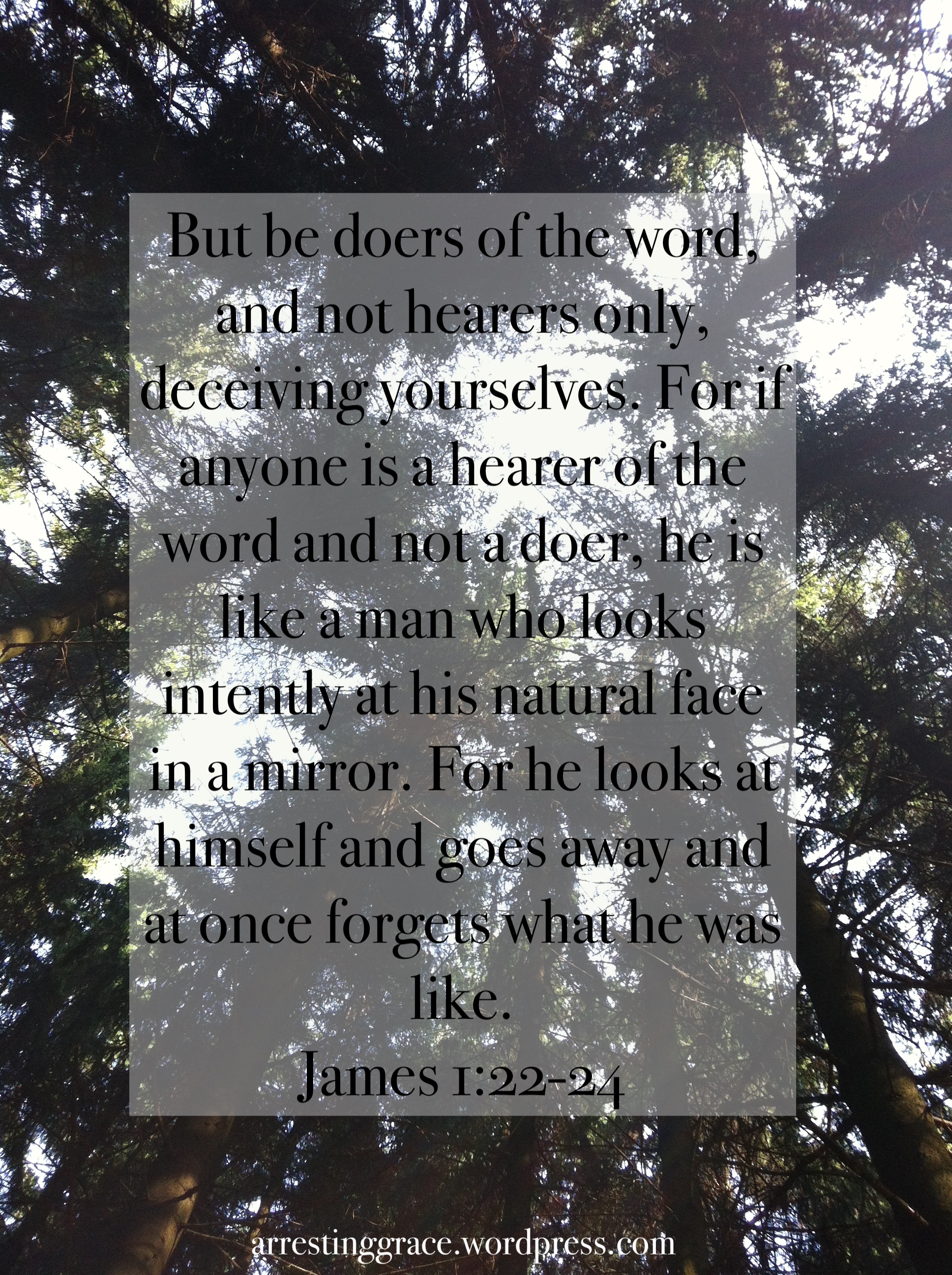
But be doers of the word, and not hearers only, deceiving yourselves. For if anyone is a hearer of the word and not a doer, he is like a man who looks intently at his natural face in a mirror. For he looks at himself and goes away and at once forgets what he was like. But the one who looks into the perfect law, the law of liberty, and perseveres, being no hearer who forgets but a doer who acts, he will be blessed in his doing. James 1:22-25

This is a great source of accountability as well. You can share your answers to question 3 with your community group and ask them to help you grow and apply these changes in your life. It is also a great encouragement to go back and see the evidence that he has changed you by the power of his Word and Spirit!

Example

Here’s an example from one of my quiet times this week. I find it helpful to write it all down, not only to help me process, but so that I can go back and remember what God taught me.

Oh, the depth of the riches and wisdom and knowledge of God! How unsearchable are his judgments and how inscrutable his ways! “For who has known the mind of the Lord, or who has been his counselor?” “Or who has given a gift to him that he might be repaid” For from him and through him and to him are all things. To him be glory forever. Amen. Romans 11:33-36

What does this teach me about God?

  • He has innumerable riches, wisdom, and knowledge.
  • His judgements are without error and his ways are unquestioningly good.
  • No one can fully know and understand God’s mind.
  • He needs no advisors or counselors.
  • God doesn’t owe anybody anything.
  • Everything is from him, through him, and for him.
  • He deserves glory forever.

What does this teach me about Man?

  • Man’s wisdom, knowledge, and riches are finite and limited.
  • We shouldn’t second guess God’s plan for us. His ways are good and unsearchable.
  • We are not God’s counselor or advisor through prayer or otherwise.
  • God doesn’t owe Mankind anything but hellfire because of sin.
  • We must give glory to God because he is everything.

How does this change me?

  • I have a thankful heart.
  • I can rest in his wisdom and sovereignty.
  • I repent of my pride, that I think God owes me.
  • Glorify God!

I pray this is helpful for you as you walk with God! This is not the only or best way to study the Bible, but it is a method that may spur you on in your study and application of God’ s Word. My prayer for each of you reading is that God will bless you with rich, sweet times with him as you abide in him and feast on the beautiful word of God.

James 1:22-24