
Deep Breath Before the Plunge

In one of my favorite books, The Return of the King, Gandalf, the venerable wizard, and Pippin, the playful but maturing Hobbit, arrive at a major city at the cusp of an enormous battle. Everyone is on edge, waiting for it to start. Gandalf calls it “the deep breath before the plunge”. I’ve been here several times in my life, on the edge of something completely life-changing.

Before I left for college, the first person in my close-knit family to leave home, move to another state, and complete a bachelor’s degree. 

Before I moved overseas, to another country to learn a new, difficult language and be immersed in a new culture. 

Before I moved back to America, not knowing in the least what was next. 

Before I got married, choosing to trade singleness for lifelong partnership. 

And now, I sit at the cusp of adopting four children, ages two to seven. I’ve taken lots of deep breaths before this plunge. These quiet moments of preparation before my “normal” is completely turned upside down are precious, and frightening at times.

In the weeks or months leading up to a big change, my heart has a tug of war with itself. I don’t like change, yet God’s given me an adventuring spirit that is willing to go into uncharted territory. All the what-ifs swirl around my head. I am a champion at worst-case-scenarios, which makes for great story-telling, but leads to anxiety in my personal life. It is all too easy to spiral down into fear and despair, long before any difficult thing actually happens. I’ve had moments of panic, wondering what in the world I was thinking when I made this decision. Surely you can’t handle this. It’s too hard. It’s too big. And too uncomfortable. 

And while those things are true of every adventure I’ve embarked on, there is another truth that rings even truer. If God asked me to do this, he will be by my side supplying grace, strength, perseverance, and wisdom to accomplish it every step of the way. This is his plan, not mine. I’m not writing this story, he is. And I must trust the Author. 

Even if nothing of the rest of my life is as I planned, expected or hoped, I will still cry out, “I have no good apart from [God]!” (Ps. 16:2). He is my never-changing Rock of Ages in the midst of the enormous, approaching change. Everything around me will look different in a few weeks, but he is and always will be the same. 

Savior.

Provider.

Faith-giver.

Way-maker.

My Rock and fortress.

My God in whom I trust. 

This leap of faith says nothing about me. I will never be able to look back and boast, “Look at all the amazing things I did.” No. I don’t have any faith in my own abilities. I am weak. I have and will fail. No, all the good in me is God’s work. He get’s all the credit and glory. I’m just a vessel, a clay jar in which he hid his surpassing treasure. He is worthy and he is with me. I’m ready for the plunge. 

“But we have this treasure in jars of clay, to show that the surpassing power belongs to God and not to us.”

1 Corinthians 4:7

The Sneaky Sin of Annoyance

Are you often annoyed? Recently I found myself discontent with my job, and as I dug deeper, I realized that I was working from a place of annoyance. I started my day anticipating annoyance, I became annoyed, then brought my annoyance home with me. 

Annoyance is often swept under the rug as a “little sin”. It’s not in the sin lists in 1 Corinthians, Galatians, Ephesians, and Colossians, so it must not be a big deal, right? Everyone gets annoyed. We’re human. We live in a broken world. It’s part of the deal. 

Yet as followers of Jesus, we must submit every part of our hearts to Christ. 

To annoy is to disturb or bother a person in a way that displeases, troubles, or slightly irritates (dictionary.com). You know the feeling. We stiffen our shoulders, furrow our brows, and bend our mouths in a frown. Our hearts grumble and groan in irritation, even if we manage to govern our body language.

What do we do when that bubble of annoyance rises in response to the day-to-day issues? 

Sin has Roots 

With my job, I was annoyed by the disruption of my schedule and the unpredictability that arose out of it. My annoyance was rooted in pride. I want to be in control, I’m not, so I’m annoyed. 

With behaviors like annoyance, it’s helpful to examine what the reaction is rooted in and where that particular sin is leading. 

Where would my job annoyance lead? I would descend into anger, discontentedness, and harshness towards others as I try to control and order my world according to my desires. 

If you are habitually annoyed about something or someone, take a moment to contemplate not just the source, but what sin your annoyance is rooted in and where it’s leading you. Sin always drags you deeper into the darkness. When you allow “small” sins to flourish, your flesh will take it one, two, or three steps further than you ever intended. 

Kill your Sin 

We must never be content with our pet sins. Christ died for our sins, yet we sometimes we pick and choose which ones we want to crucify and submit to his lordship. 

God wants us to walk in righteousness in all things. We won’t be perfect this side of eternity, but this is a battle we must fight as believers. “Be killing sin or it will be killing you” (John Owen). 

Let’s be honest. “I’m annoyed” is a more acceptable way of saying “I’m mildly angry”. Anger can be righteous (Scripture tells us that both God and Jesus were angry at times), but our anger is rarely righteous. Our anger is most often rooted in pride and selfishness. 

Scripture has a lot to say about anger. Wisdom literature is rife with examples of anger leading to sin and strife (Prov. 14:29, 29:22, Ecc. 7:9). 

Paul instructs is in Ephesians: 

Be angry and do not sin; do not let the sun go down on your anger, and give no opportunity to the devil.

Eph. 4:26-27

Let all bitterness and wrath and anger and clamor and slander be put away from you, along with all malice.

Ephesians 4:31

James also speaks to us about anger: 

Know this, my beloved brothers: let every person be quick to hear, slow to speak, slow to anger; for the anger of man does not produce the righteousness of God.

James 1:19-20

Annoyance also leads us to grumbling and complaining. Paul says in Phil. 2:14-15: 

Do all things without grumbling or disputing, that you may be blameless and innocent, children of God without blemish in the midst of a crooked and twisted generation, among whom you shine as lights in the world. 

Recalibrate your Response

When annoyance comes (and it will), consider these practical steps:

  • Take deep breath to calm your body.
  • Think through the sin-root of your annoyance and where it will lead. 
  • Confess sin (unbelief, pride, selfishness, etc). 
  • If you follow Jesus, remember God’s promise that you are forgiven in Christ. If you don’t have a relationship with God through Jesus, check this out.
  • Choose a scripture to memorize and meditate on to set your mind on Christ instead of yourself. 
  • Share with accountability partner(s) for prayer and support. 

Don’t let sneaky sins trip you and tear you down from the joy-filled, righteous life Christ purchased for you on the cross. Walk in freedom. 

When Hope Hurts

I did it again. I worked on my Pintrest nursery board. I mentally counted the months and estimated the due date. I thought through how and when we’d tell our families. I imagined holding a tiny human with my husband’s eyes, listening to infant squeaks. But with familiar pangs in my empty womb came the lance of reality. No baby. 

Hope is a beautiful thing, but what if hope becomes an enemy? What if, in this season of life, hope is cruel, risky, and unfulfilled? What do we do when hope hurts? 

Hope is a feeling of anticipation and a desire for a certain thing to happen. This anticipation and its appeal is universal. Hope is the central agent of change in storytelling and great epics: Luke to the Rebellion, Frodo to the Fellowship, and Harry to the good wizards and witches.

Hope can affect our bodies as well as our minds. Researchers learned that hope can even alter neurochemistry, mimicking the effects of morphine by releasing endorphins and enkephalins to block pain (Jerome Groopman). 

Hope in Scripture

Hope is a central theme of the Bible. In the Old Testament, the word hope is used eighty-eight times (ESV). Many of these passages express the anticipation of the Messiah and the fulfillment of God’s promises to Abraham and the Israelites. Job, a book centered on suffering, uses “hope” twenty-one times, and it appears twenty-eight times in the Psalms, a book in which the psalmist doesn’t shy away from expressing anguish, fear, and joy to God. 

In the New Testament, we see the disciples’ hope that Jesus is the Messiah. Peter was one of the first to recognize Jesus was the Christ (Matt. 16:16). He promised to never deny him, and even to die with him (Matt. 26:33-35). Peter’s hope was so utterly crushed after denying Jesus three times, he wept bitterly (Matt. 26:75). Yet on the third day after Jesus’ death, Peter himself ran to the tomb and found it empty. Later Jesus appeared and restored him. Hope kindled. Hope lost. Hope restored. Hope fulfilled. 

What do we do when we find ourselves pierced by hope like Peter, left broken and weeping bitterly? 

Shift your Hope

In an oft repeated refrain, the psalmist writes,

“Why are you cast down, O my soul,
    and why are you in turmoil within me?
Hope in God; for I shall again praise him,
    my salvation and my God.”

Ps. 42:11

When hopes are dashed and all seems the darkest, hope in God. Hope, when placed in God, is an unquenchable beacon in the night. God will not fail us. His faithfulness knows no end. He is unchangeable, all powerful, sovereign, good, and just.

If our ultimate hope is in God and his provision in Christ to cover our sin, our darkest day on earth will be the closest we ever get to hell. Even when we  see the whites of the eyes of the enemy and feel him breathing down our neck, we have unshakeable hope. We are in Christ, perfect and complete, made righteous and holy through the blood of the Lamb. Our hope is founded not in this world, but in the eternal Kingdom of God. 

Don’t Lose Heart

Do you hope for rest?Come to me, all who labor and are heavy laden, and I will give you rest. Take my yoke upon you, and learn from me, for I am gentle and lowly in heart, and you will find rest for your souls. For my yoke is easy, and my burden is light” (Matt. 11:28-30).

Do you hope for peace? Do not be anxious about anything, but in everything by prayer and supplication with thanksgiving let your requests be made known to God. And the peace of God, which surpasses all understanding, will guard your hearts and your minds in Christ Jesus” (Phil. 4:6-7).

Do you hope for joy?You make known to me the path of life; in your presence there is fullness of joy; at your right hand are pleasures forevermore” (Ps. 16:11).

Do you hope for restoration?And after you have suffered a little while, the God of all grace, who has called you to his eternal glory in Christ, will himself restore, confirm, strengthen, and establish you” (1 Peter 5:10).

Do you hope to be rid of your flesh?And I am sure of this, that he who began a good work in you will bring it to completion at the day of Jesus Christ” (Phil. 1:6). 

Dear one, do not lose heart. God knows and sees the hope that hurts you. Don’t put your hope in temporary things. Rest in your ultimate hope, the Lord, and bask in the assurance that his hope will never be foiled or disappointed. We will one day be with him.

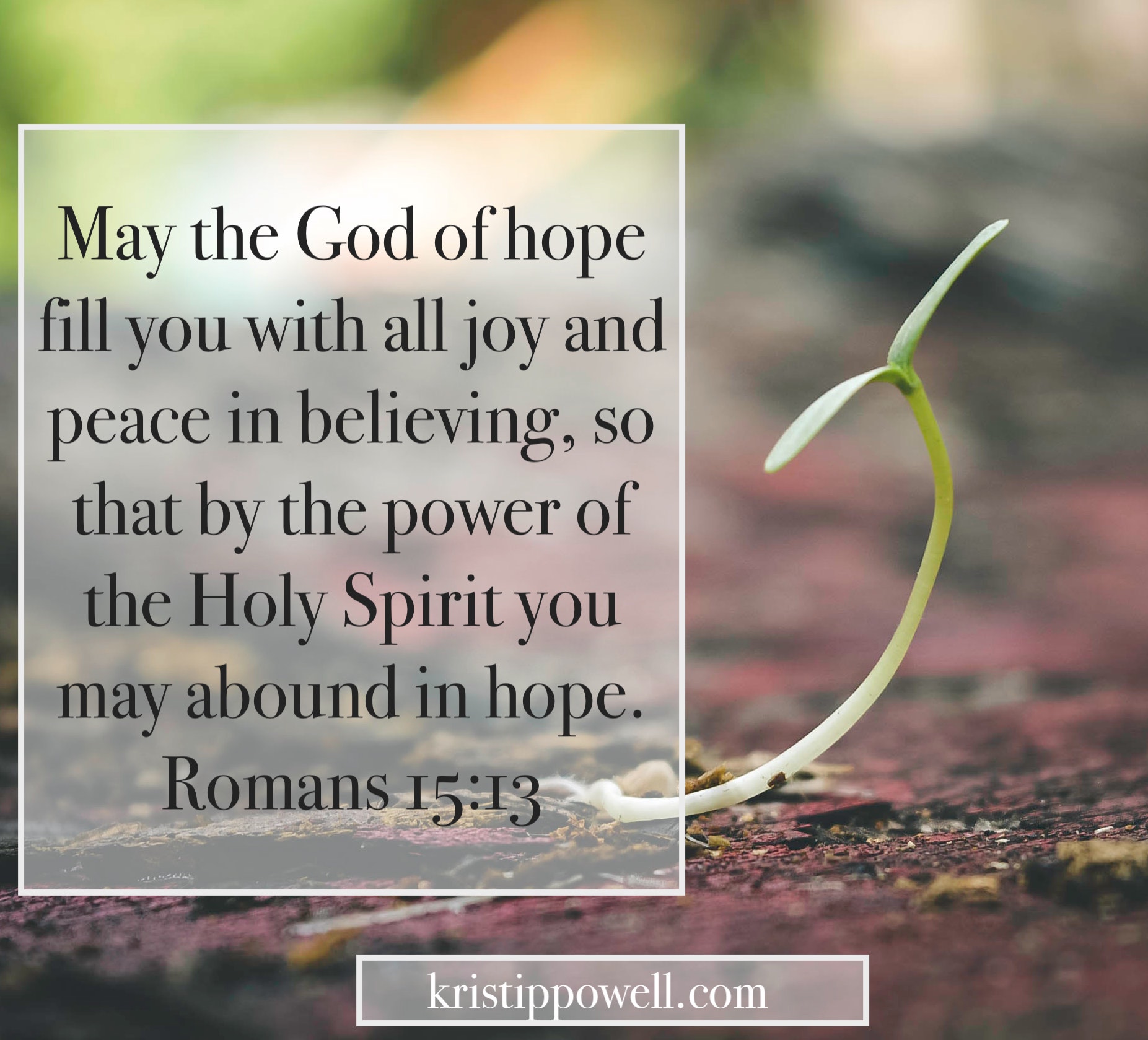
May the God of hope fill you with all joy and peace in believing, so that by the power of the Holy Spirit you may abound in hope.

Romans 15:13
photo from pixels.com

The 3 Questions – How to study the Bible

In college I had a semester long course dedicated to teaching how to study and interpret the Bible. It even had a fancy name: Hermeneutics.  We were assigned difficult passages in the Old and New Testament to write papers on, explaining the text. I spent hours poring over commentaries in the eerily quiet library. I didn’t realize how privileged I was to benefit from hundreds of years of Christian teaching and tradition in those musty volumes.

Several years later, I found myself in a very different context. I lived in a country that didn’t even sell Bibles in bookstores. I couldn’t bring any of my books with me. Suddenly my Bible sat alone on the shelf. I’d relied so long on the plethora of spiritual resources that when they were taken away, I was faced with this all important question: how do I study the Bible? How do I dig in and mine the truths from the Word, understand it, treasure it, and apply it on a daily basis?

Dear friends taught me the Three Questions method of Bible study that can be done in a group or in personal study. It can be used by people who became believers this morning or those who’ve walked with Jesus for fifty years. It is simple, easy to remember, and effective.

Gold and Honey

First, take a moment to ask the Holy Spirit to reveal truth to you. Apart from the Spirit, we are dead to the Word of God (1 Cor. 2:12). Submit yourself to God and in humility ask for understanding.

Next, the text must be read. The law, testimony, and decrees of the Lord are to be more desired than fine gold, and it is sweeter than honey (Ps. 19:10). We may be in different seasons, able to devote more or less time to study, but no matter what’s going on, don’t forsake the Book. Read it. Treasure it. Meditate on it! Devotional books and apps are helpful, but Scripture must be the center of our study. Read it in your heart language, the language you think in. If the Bible hasn’t been translated into your heart language, read it in a language you understand, then write down a paraphrase of the verses you’re studying in your heart language.

It is helpful for me to write the scripture that I’m studying or meditating on. Writing helps me process the information better and it sticks with me longer. Do whatever helps you understand the Word. Read it, sing it, write it, listen to it. Abide!

3 Questions

Then we ask ourselves three questions about the text:

  1. What does this teach us about God?
  2. What does this teach us about Man?
  3. How does this change me? (application)

We must always start with God. We learn about his character, attributes works, and commandments. Next, we look at Mankind, people, ourselves. The text gives us godly examples to follow, foolish examples to avoid, and truths about our innermost workings. Lastly, we apply what we learn. The Word of God should change us. We shouldn’t read, close the Bible and walk away the same as before.

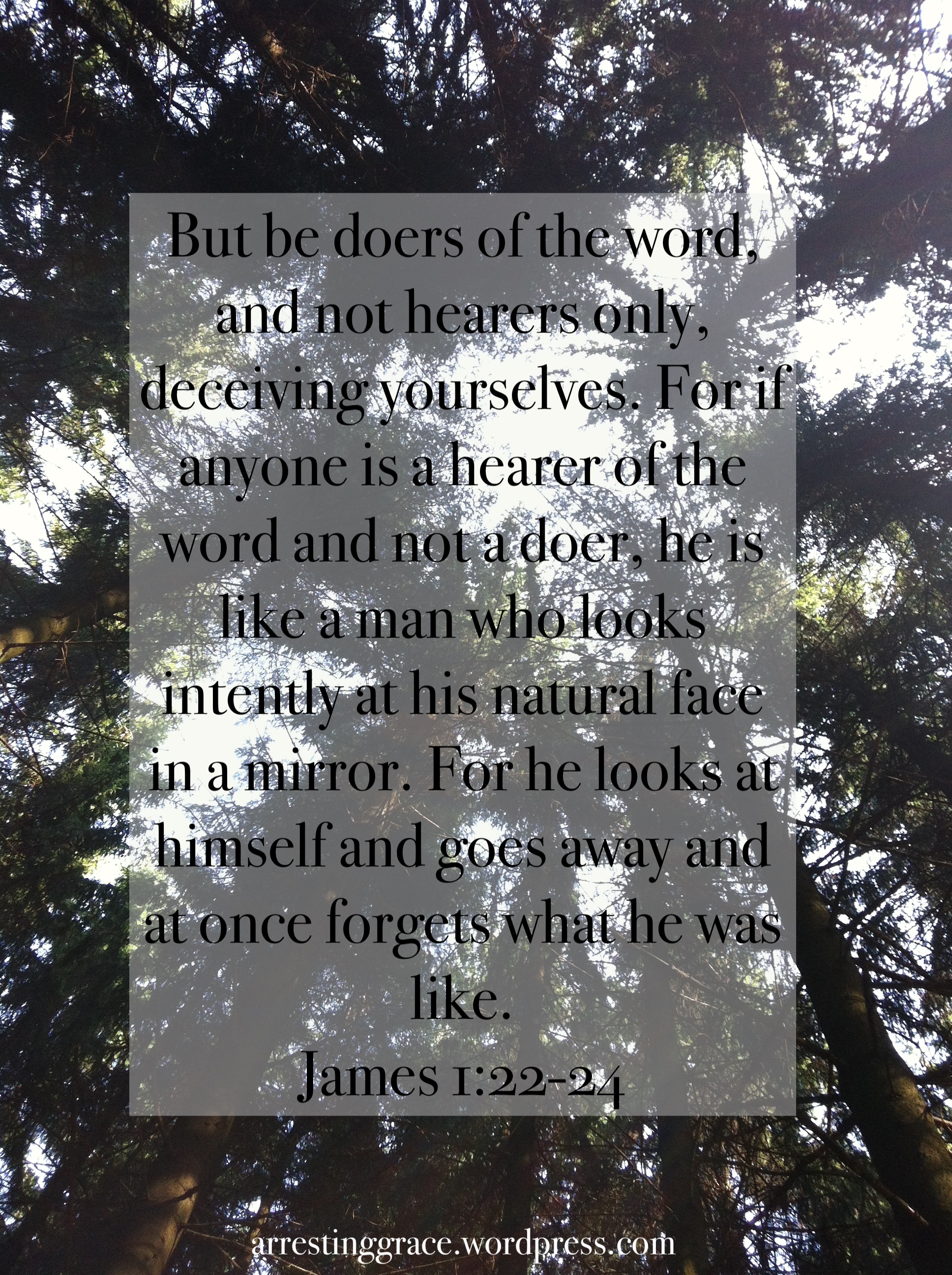
But be doers of the word, and not hearers only, deceiving yourselves. For if anyone is a hearer of the word and not a doer, he is like a man who looks intently at his natural face in a mirror. For he looks at himself and goes away and at once forgets what he was like. But the one who looks into the perfect law, the law of liberty, and perseveres, being no hearer who forgets but a doer who acts, he will be blessed in his doing. James 1:22-25

This is a great source of accountability as well. You can share your answers to question 3 with your community group and ask them to help you grow and apply these changes in your life. It is also a great encouragement to go back and see the evidence that he has changed you by the power of his Word and Spirit!

Example

Here’s an example from one of my quiet times this week. I find it helpful to write it all down, not only to help me process, but so that I can go back and remember what God taught me.

Oh, the depth of the riches and wisdom and knowledge of God! How unsearchable are his judgments and how inscrutable his ways! “For who has known the mind of the Lord, or who has been his counselor?” “Or who has given a gift to him that he might be repaid” For from him and through him and to him are all things. To him be glory forever. Amen. Romans 11:33-36

What does this teach me about God?

  • He has innumerable riches, wisdom, and knowledge.
  • His judgements are without error and his ways are unquestioningly good.
  • No one can fully know and understand God’s mind.
  • He needs no advisors or counselors.
  • God doesn’t owe anybody anything.
  • Everything is from him, through him, and for him.
  • He deserves glory forever.

What does this teach me about Man?

  • Man’s wisdom, knowledge, and riches are finite and limited.
  • We shouldn’t second guess God’s plan for us. His ways are good and unsearchable.
  • We are not God’s counselor or advisor through prayer or otherwise.
  • God doesn’t owe Mankind anything but hellfire because of sin.
  • We must give glory to God because he is everything.

How does this change me?

  • I have a thankful heart.
  • I can rest in his wisdom and sovereignty.
  • I repent of my pride, that I think God owes me.
  • Glorify God!

I pray this is helpful for you as you walk with God! This is not the only or best way to study the Bible, but it is a method that may spur you on in your study and application of God’ s Word. My prayer for each of you reading is that God will bless you with rich, sweet times with him as you abide in him and feast on the beautiful word of God.

James 1:22-24

The Pit of Despair – Part 2

When Stranger Things became somewhat of a cultural phenomenon, I broke my no horror rule and watched it. The first season was torture. Every little glimpse of the monster had me on the edge of my seat. I had nightmares a few times and stopped watching it before I went to bed. It was killing me that I didn’t know what the monster was. “Just tell me!” I begged my husband, who had already finished the season. “If I know what the monster is I can handle it!”

I felt the same way about anxiety. If I could see it, examine it, understand it, I could get over it. However the more I probed it, the greater my anxiety grew. I didn’t understand this monster and it terrified me. I’m not alone. Women seem to especially struggle with worry and anxiety. What does God have to say to women who are stalked by this beast?

Do not be anxious about anything, but in everything by prayer and supplication with thanksgiving let your requests be made known to God. And the peace of God, which surpasses all understanding, will guard your hearts and your minds in Christ Jesus. Philippians 4:6-7

“Therefore I tell you, do not be anxious about your life, what you will eat or what you will drink, nor about your body, what you will put on. Is not life more than food, and the body more than clothing? Look at the birds of the air: they neither sow nor reap nor gather into barns, and yet your heavenly Father feeds them. Are you not of more value than they? And which of you by being anxious can add a single hour to his span of life?” Matthew 6:25-27

However when I was gripped by anxiety, it seemed God was simply saying in these verses, “Don’t feel this way”. That is far from the truth! God doesn’t want us to be anxious and worried. He wants us to be dependent on him for all things and walk in joy, no matter our circumstances. Below are some nuts and bolts of leaning on God as we struggle with anxiety.

Lament and Turn

I loved the Psalms since I was a little girl, but anxiety caused me to mine from their depths deep, raw truths. David faced much pain in his life, and his psalms of lament are full of emotion, raw, and unfiltered.

How long, O Lord? Will you forget me forever? How long will you hide your face from me? How long must I take counsel in my soul and have sorrow in my heart all the day? Psalms 13:2-3

I am weary with my moaning; every night I flood my bed with tears; I drench my couch with my weeping. My eye wastes away because of grief; it grows weak because of all my foes. Psalms 6:6-7

I could honestly pray these psalms word for word. I was right there with David in the pit. But his eyes were turned upwards. After confessing his pain, confusion, and suffering, the Psalmist reaffirms his faith in God’s character and deliverance.

But I have trusted in your steadfast love; my heart shall rejoice in your salvation. I will sing to the Lord, because he has dealt bountifully with me. Psalms 13:5-6

When we’re in the throes of anxiety, God doesn’t want us to pretend everything is ok. We can cry out to him and confess our weakness, frustration, and pleas for help. However, don’t camp out at lament. Turn to God and read his promises. His words may not feel true in that moment, but ask for faith to believe and trust that they are true.

Don’t follow your heart

Anxiety is physical. The heart racing, limb trembling, chest tightening, chill wracking beast can leap on you in the matter of second. As a woman who is wired to process things first by feeling, anxiety wrecked my baseline.

Looking back, I see God’s mercy. I relied on myself for far too long. Through anxiety, he taught me that we cannot make feelings the plumb line for our lives. Only God and his Word have that authority in the life of a believer! No matter what we feel, God’s Word is true. He’s always faithful. Read God’s promises. Memorize them. Sing them. Weep them. Plea with them. They may feel far off, but they are true. God is true to his Word and he never fails, even when we do (Psalms 73:26).

Flee to the Cross

In the end, allowing our thoughts dwell on worry and fear is a sin like any other. We are all fallen creatures, unable to attain the righteousness God requires. We’ve all fallen into the pit, stale dry bones, unable to raise ourselves out. Yet God does not leave us there. He comes down into the pit to bring us out. He breathes life into us, takes us in, mends us, restores us, and makes us his daughters. Oh, sweet, beautiful truth! We need not despair when we find ourselves wrestling with our darkest monsters. Our God is a warrior king! He sent Jesus Christ to destroy the serpent, the evil one who coaxed the rotting carcass of sin into this world. He crushes our sin through the power of his Spirit, and we are free to walk in newness of life! Amen!

In his presence

In the midst of a panic attack, my mom held me tight and rocked me like I was a child again. “You won’t feel this way forever.” She whispered. She was right, and God gives an even greater promise.

You make known to me the path of life; in your presence there is fullness of joy; at your right hand are pleasures forevermore.” Psalms 16:11

Because we are daughters of God, we are given the Holy Spirit (Eph. 1:13). We are in the presence of God every moment because of this remarkable gift. In God’s presence there is fullness of joy. Does your heart swell like mine when you read that? We find fullness of joy in the midst of life’s most difficult circumstances because God is with us. Praise him!

Resources:

https://erlc.com/resource-library/articles/learning-to-lament-4-lessons-from-psalms https://www.desiringgod.org/articles/your-emotions-are-a-gauge-not-a-guide